

Who Are You Without Your Masks?
- Feroz Anka
- May 23
- 8 min read

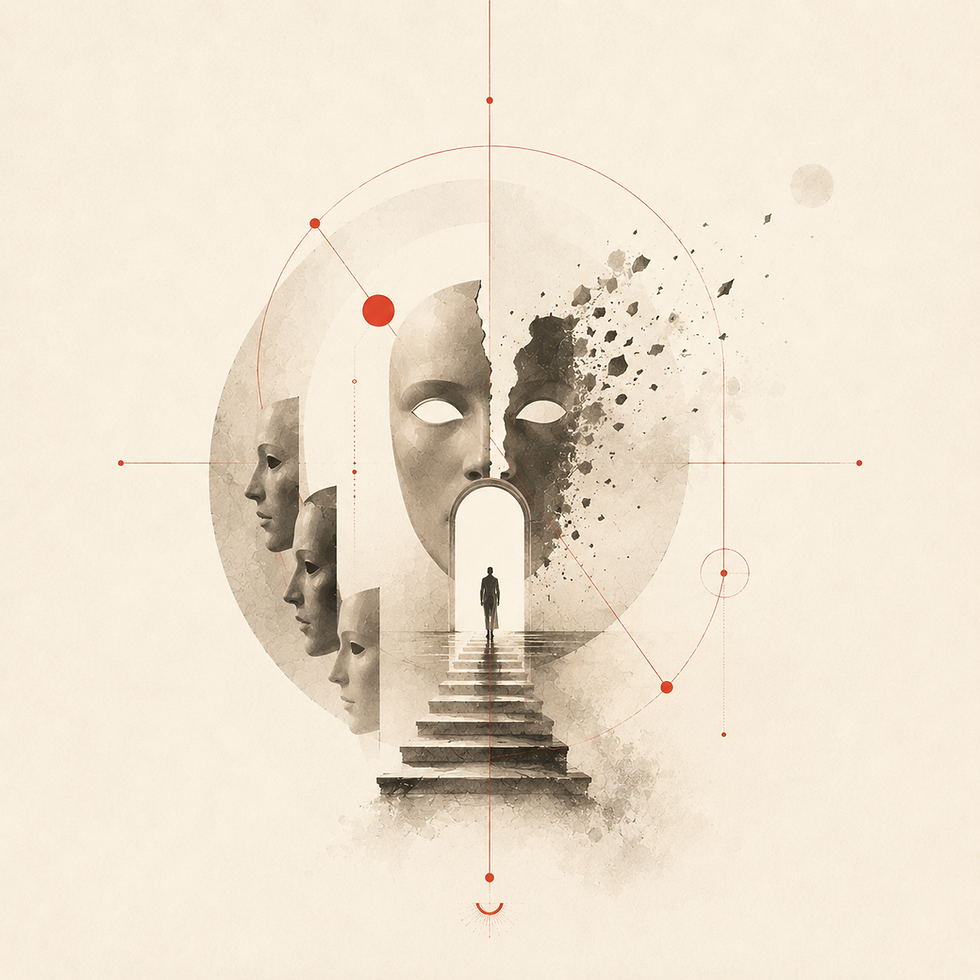
Most of us do not notice the masks we wear — because the world rewards us for wearing them well.
We learn early how to become legible. We are given names, roles, titles, expectations, and acceptable versions of ourselves. We learn which face opens doors, which silence avoids conflict, which tone sounds professional, which wound should stay hidden, which smile keeps the room comfortable.
At first, the mask helps us belong.
Then, slowly, it begins to replace the face.
This is one of the quiet questions inside Lines of the Void: what happens when the symbols we created to understand ourselves become the structures that imprison us?
A name can help others recognize us.
A role can give us a place.
A title can explain what we do.
But none of them can hold the whole human being.
So the question remains:
Who are you when the mask no longer has to survive?
The Masks That Help Us Belong
A mask is not always a lie.
Sometimes it is a language.
Sometimes it is protection.
Sometimes it is the first architecture of belonging.
We wear masks because the world is rarely patient with the unedited self. A child learns quickly which emotions are welcome and which ones disturb the room. An adult learns which parts of the self are useful, marketable, respectable, desirable, or safe.
So we become readable.
The professional becomes efficient.
The parent becomes reliable.
The leader becomes certain.
The artist becomes original.
The believer becomes steady.
The wounded one becomes “strong.”
These roles are not meaningless. They help us move through the social world. They give form to our responsibilities. They allow others to know where to place us.
But a role becomes dangerous when it forgets that it is only a role.
A mask becomes dangerous when it begins to ask for skin.
When a Role Becomes a Prison
There is a kind of exhaustion that comes not from work, but from performance.
The person who is always competent cannot collapse.
The person who is always kind cannot admit resentment.
The person who is always strong cannot ask to be held.
The person who is always wise cannot confess confusion.
And so the mask becomes a room without windows.
What began as a social form becomes an inner sentence. The human being is reduced to the function they perform. A profession becomes a personality. A title becomes a cage. A reputation becomes a guard standing at the door of the self.
This is why the question of identity is never only personal. It is also symbolic.
In When Words Become Walls: How Language Imprisons Reality, language becomes one of the most delicate prisons of perception: a word begins by naming something, then slowly decides what that thing is allowed to be.
The same happens with identity.
A name is placed on us.
Then a role.
Then an expectation.
Then a story.
And eventually, we begin to live inside the story as if no other self had ever existed.
The Architecture of Approval
The mask survives because approval feeds it.
Every social world has its own currency. Sometimes it is praise. Sometimes obedience. Sometimes visibility. Sometimes admiration. Sometimes the quiet reward of not disappointing anyone.
The self learns to trade.
A little truth for acceptance.
A little silence for peace.
A little exhaustion for recognition.
A little performance for belonging.
And over time, the difference between being seen and being known begins to disappear.
But being seen is not the same as being known.
To be seen is to appear inside another person’s perception.
To be known is to be received without needing to perform the approved version of yourself.
The mask can be seen.
Only the self can be known.
What part of you has never needed applause?
Ego as a Border Around the Self
The ego is not simply arrogance.
Often, it is a border.
It says: this is me, that is not me. This is my image, my control, my title, my wound, my success, my failure, my story.
The ego draws a line around the self and then asks the world to respect the drawing.
But the living self is rarely so clear.
It is not a fixed object. It changes. It contradicts itself. It remembers what it thought it had forgotten. It becomes softer in one season and harder in another. It is wounded by things it cannot explain. It is healed by things it did not expect.
A mask wants consistency.
The self needs truth.
And truth is rarely consistent enough to become a brand.
This is why the ego clings to symbols: names, titles, possessions, achievements, beliefs, roles. They make the self feel stable. They provide an outline. They reduce the terror of becoming.
But the outline is not the life.
The same wound appears again in The Map Is Not the World: Why We Mistake Symbols for Reality, where the symbol begins as a tool, then slowly replaces the terrain it was meant to serve.
A role is a map.
A title is a map.
A biography is a map.
But the self is the terrain.
Which Role Would Frighten You Most to Lose?
Some masks are so deeply attached that losing them feels like losing existence itself.
Who are you if you are no longer useful?
Who are you if you are no longer admired?
Who are you if you are no longer needed?
Who are you if you are no longer successful?
Who are you if you are no longer the strong one?
Who are you if you are no longer the one who understands?
The role we are most afraid to lose often reveals the place where the mask has fused with the wound.
A person may cling to success because they fear being unseen.
Another may cling to control because they fear abandonment.
Another may cling to kindness because they fear rejection.
Another may cling to intelligence because they fear being ordinary.
The mask is rarely random.
It often grows around the place where the self once felt unsafe.
This is why removing it cannot be a violent act. The mask once protected something. It should not be torn away with cruelty. It should be loosened with honesty.
A person does not become real by destroying every role.
A person becomes real by remembering that no role is allowed to become the whole self.
The Digital Mask
The modern world has added another layer to the old human performance: the digital self.
Here, the mask becomes measurable.
A face becomes a profile.
A thought becomes content.
A life becomes a sequence of visible moments.
A feeling becomes a caption.
A wound becomes aesthetic.
A self becomes a surface.
The digital mask is seductive because it gives the illusion of being known while often keeping the real self untouched.
People can watch your life without entering it.
They can react to your image without carrying your silence.
They can know your updates and still not know your grief.
Visibility is not intimacy.
Sometimes the more visible a person becomes, the more hidden they feel.
The danger is not simply that we perform for others. The danger is that we eventually begin to perform for ourselves. We start asking how life will appear before we ask how it feels. We begin editing the moment while still inside it.
The mask becomes not only something we wear.
It becomes the mirror through which we judge whether we exist.
The Fear of Removing the Mask
To remove a mask is frightening because the mask gives structure.
Without it, there may be silence.
There may be uncertainty.
There may be grief.
There may be a self that has not been spoken to for years.
Many people do not fear being false.
They fear what may appear if the performance stops.
Who am I without the role?
Who will stay if I stop being useful?
What will remain if I stop explaining myself through achievement, identity, strength, or pain?
These are not small questions.
They are thresholds.
The fear of removing the mask is often the fear of entering the void beneath the identity. But that void is not necessarily emptiness. Sometimes it is the first honest room.
The place where the self can finally breathe without being translated.
Control and the Mask
A mask is also a form of control.
It controls how much of us is seen. It controls the story others receive. It controls the distance between the inner life and the outer appearance.
But control has a cost.
The more carefully we manage the mask, the less freely the self can move behind it.
This is where Letting Go of Control: The Quiet Philosophy of Freedom continues the reflection: if identity is a mask, control is often the hand trying to keep that mask in place.
To let go does not mean becoming shapeless.
It means no longer forcing the living self into a fixed image.
A river does not become free by pretending it has no banks.
It becomes free by moving.
The self also needs movement.
It needs the right to change, to contradict, to soften, to confess, to rest, to begin again.
A mask freezes the self in one acceptable posture.
Truth lets it breathe.
The Quiet Self Behind the Performance
Behind the mask, there is often not a dramatic revelation.
There is something quieter.
A tired self.
A tender self.
A self that does not know what to say.
A self that has been performing fluency while carrying confusion.
A self that wants to be received without being useful.
A self that wants to exist before being named.
The true self may not arrive as a clear answer.
It may arrive as relief.
A long breath after a difficult performance.
A crooked sentence spoken without decoration.
A silence shared without fear.
A moment in which nobody asks you to become more impressive than you are.
If the mask becomes performance, Sincerity Has No Stage: Why Authenticity Dies When It Performs shows how even authenticity can collapse when it begins to perform itself.
Because sincerity does not need a spotlight.
It needs a room where the human being can finally enter without costume.
Who Are You When Nobody Is Watching?
This question is not meant to accuse.
It is meant to return.
Who are you when nobody is watching?
Who are you when no one is rewarding your role?
Who are you when the title is not useful?
Who are you when the applause ends?
Who are you when the image no longer needs to be managed?
Perhaps the answer is not immediate.
Perhaps the first honest answer is silence.
And perhaps silence is not failure. Perhaps it is the self arriving late, after years of being interrupted by its own masks.
To live without masks entirely may be impossible. Human beings need forms, manners, roles, and names. But they also need spaces where these forms can loosen.
A life becomes dangerous when there is no place where the mask may rest.
Beyond the Mask
The journey is not toward becoming formless.
It is toward no longer confusing the form with the self.
Wear the role when it is needed.
Use the name when it is useful.
Carry the title when it serves.
Enter the world with enough shape to be understood.
But do not disappear inside the shape.
You are not only what others can recognize.
You are not only what language can introduce.
You are not only what your role can explain.
The mask may help you belong to the world.
But only the self can belong to truth.
Continue the Path
If this question stayed with you, enter Lines of the Void — where the journey begins exactly there, behind the mask.
You may also continue with When Words Become Walls: How Language Imprisons Reality, where names and roles reveal how language can imprison reality, or Letting Go of Control: The Quiet Philosophy of Freedom, where the hand finally begins to loosen its grip around life.
For a darker continuation of this question, read Sincerity Has No Stage: Why Authenticity Dies When It Performs — where authenticity itself is stripped of performance and returned to the broken warmth of a real sentence.
Perhaps the true self is not something we build, but something we stop covering.


Comments